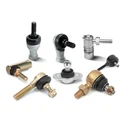

Rod end bearings, also known as heim joints, are a special type of spherical plain bearing that integrates a spherical bearing with a threaded rod or housing. Their unique structure consists of an inner ring with a spherical outer surface and an outer ring (rod end) with a spherical inner surface, allowing the inner ring to rotate and oscillate freely within the outer ring. This design enables rod end bearings to accommodate angular misalignment, making them ideal for applications where the direction of the load changes or the two connected components have a certain degree of misalignment.
One of the main advantages of rod end bearings is their compact structure. Compared with other types of bearings used for similar purposes, they occupy less space, which is particularly important in equipment with limited installation space, such as automotive suspension systems and aircraft control linkages. Additionally, rod end bearings have good load - carrying capacity, and they can bear both radial and axial loads simultaneously, although their axial load - carrying capacity is relatively weaker than their radial load - carrying capacity.
The material selection of rod end bearings is closely related to their application environment. Common materials include carbon steel, alloy steel, and stainless steel. Carbon steel rod end bearings are cost - effective and suitable for general industrial applications with low corrosion requirements. Alloy steel bearings have higher strength and wear resistance, making them suitable for heavy - duty equipment like construction machinery. Stainless steel bearings, on the other hand, have excellent corrosion resistance, which is essential for marine equipment, food processing machinery, and medical equipment that operate in humid or corrosive environments.
Application fields of rod end bearings are very extensive. In the automotive industry, they are used in steering systems and suspension linkages to ensure smooth movement and reliable transmission of forces. In the agricultural machinery sector, they are applied in tractor linkages and harvester control mechanisms, adapting to the harsh working conditions in fields. In the construction industry, they are used in cranes and excavators, withstanding heavy loads and frequent angular adjustments. Moreover, in sports equipment such as fitness machines and racing simulators, rod end bearings provide flexible movement, enhancing the user experience.