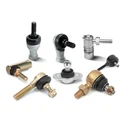

Proper installation of rod end bearings is essential to ensure their normal operation and service life. Before installation, it is necessary to clean the bearing and the installation parts thoroughly to remove any dirt, debris, or burrs. Any impurities left on the bearing surface or in the installation holes can cause increased friction during operation, leading to premature wear and reduced precision.
The installation process should follow the correct torque requirements. When tightening the threaded connection of the rod end bearing, an appropriate torque wrench should be used to avoid over - tightening or under - tightening. Over - tightening can cause deformation of the bearing inner or outer ring, affecting the rotational flexibility, while under - tightening may result in loose connections, leading to abnormal noise and vibration during operation. The specific torque value should be determined according to the bearing size, material, and application requirements, and it is recommended to refer to the manufacturer's installation manual.
Another important installation consideration is the alignment of the bearing. Although rod end bearings can accommodate a certain degree of angular misalignment, excessive misalignment will increase the internal stress of the bearing, accelerate wear, and even cause bearing damage. Therefore, during installation, it is necessary to ensure that the bearing is aligned with the connected components as much as possible, and adjust the installation position if necessary to reduce the angular misalignment to within the allowable range specified by the manufacturer.
In terms of troubleshooting, common issues with rod end bearings include abnormal noise, increased friction, and reduced load-bearing capacity. Abnormal noise during operation may be caused by insufficient lubrication, spherical wear, or loose connections. At this point, the bearing should be disassembled and inspected, and if necessary, lubricant should be added or the bearing replaced. Increased friction may be due to impurities entering or bearing ring deformation, which requires cleaning the bearings or replacing damaged parts. A decrease in bearing capacity is usually a sign of severe wear or damage to the bearing, and the bearing must be replaced immediately to avoid equipment failure.
Regular maintenance and inspection can effectively prevent the occurrence of faults. It is recommended to check the rod end bearings every 3 - 6 months, including checking the lubrication status, the tightness of the connections, and the wear of the spherical surface. By promptly identifying and solving potential problems, the service life of the bearings can be extended, and the stable operation of the equipment can be guaranteed.