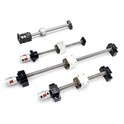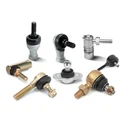

Linear bearings, as key components in the field of modern industrial precision transmission, play an irreplaceable role in precision machinery, automation equipment, CNC machine tools and other fields with their unique design principles and technical advantages. Its technical characteristics directly reflect the core needs of modern high-end manufacturing for efficiency and stability.
Linear bearings use rolling body linear motion to achieve low-friction sliding through precise contact between steel balls or rollers and guide rails. This design makes the friction coefficient significantly lower than that of traditional sliding bearings, reduces energy loss, and improves the operating efficiency of equipment. Especially in high-load cycle scenarios, its wear resistance is particularly obvious, greatly extending the service life of the equipment.
Compact structure is another major technical highlight of linear bearings. The modular design allows the system to integrate a simpler transmission mechanism, which not only saves installation space, but also reduces maintenance difficulty through standardized components. The internal self-lubricating design further simplifies the configuration requirements of the external lubrication system, showing unique advantages in harsh environments such as medical equipment and food processing.
In terms of dynamic performance, linear bearings have both high rigidity and flexibility. Its rigidity can effectively resist bending deformation and ensure the precision of precision motion control; while its flexibility allows stable transmission in small displacements, which makes it widely used in high-precision scenarios such as semiconductor processing equipment and optical instrument calibration systems.
These technological breakthroughs in linear bearings not only promote the intelligent upgrading of traditional mechanical equipment, but also provide underlying support for the development of multi-axis linkage control systems in the era of industrial Internet. As the process of Industry 4.0 accelerates, this basic component will continue to iterate and become an indispensable core component in the intelligent manufacturing system.