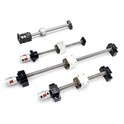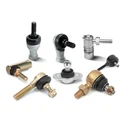

Core Value: The "Precise Motion Skeleton" of Industrial Equipment
In today's rapidly evolving industrial landscape, linear bearings-acting as core transmission components of mechanical systems-have seen their importance continuously highlighted with the advancement of intelligent manufacturing. They provide high - precision linear motion guidance for equipment and are widely used in automated production lines, precision instruments, new energy equipment and other fields. They directly boost production efficiency by over 30% (e.g., reducing the cycle time of automotive welding production lines), serving as a key support for the "efficient + precise" operation of industry.
Functional Upgrade: The "Dual - Dimensional Load - Bearing" for Radial + Axial Loads
The core mission of linear bearings is to guide objects to move linearly and provide support. Unlike traditional ball bearings (which only focus on radial load - bearing), through optimized raceway designs (such as spherical/cylindrical contact structures), they can simultaneously bear radial and axial loads, ensuring stable operation under high - speed (e.g., 12,000 rpm for CNC spindles) and high - precision (±0.001 mm positioning) working conditions.
This advantage allows them to break the limitation of "single - load bearing" and become a core component in industries such as automated equipment (e.g., SCARA robots), precision measuring instruments (e.g., coordinate measuring machines), printing machinery (e.g., high - speed gravure printers), and food packaging lines (e.g., pillow - type packaging machines). It solves the pain points of traditional bearings, such as "easy jamming at high speeds and easy deformation under multi - directional loads".
Product Matrix: Multi - dimensional Coverage from "Light - load General - purpose" to "Heavy - load Special - purpose"
The refined stratification of market demand has promoted the technical iteration of linear bearings. Currently, the mainstream products are divided into three categories:
| Product Type | Applicable Scenarios | Core Features |
| Light - load Type | Home appliances, small - scale automated equipment | Low cost, small size (e.g., φ6 - φ20 mm) |
| Heavy - load Type | Machine tools, engineering machinery | High rigidity, impact resistance (load up to 10⁴ N level) |
| Special - type Type | Corrosive/high - temperature environments (chemical, metallurgy) | Anti - corrosion (PTFE coating), high - temperature resistance (ceramic - based) |
In addition, enterprises continuously optimize for differentiated working conditions:
- Material End: Stainless steel (anti - corrosion), engineering plastics (weight reduction and noise reduction), ceramics (high - temperature resistance), etc. are adopted;
Structural End: "Self - aligning" and "sealed dust - proof" designs (e.g., IP65 protection level) are developed to extend the service life to more than 5,000 hours.
Technological Innovation: "Two - way Breakthrough" of Materials × Processes
Facing the demands of high - end and customized products, the industry's R & D focuses on two directions:
Material Innovation:
- Nano - coatings (e.g., DLC diamond - like coatings): Reduce the friction coefficient to below 0.01, reducing energy consumption;
- Composite materials (e.g., carbon fiber + metal matrix): Achieve "lightweight + high strength" (weight reduced by 40%, strength increased by 20%).
Process Upgrading:
- Ultra - precision machining (e.g., slow - wire cutting): Control the raceway roughness within Ra0.05 μm, further improving motion smoothness;
- Digital modeling (finite element analysis): Optimize load distribution, increasing the accuracy of bearing life prediction to more than 95%.
Enterprises' R & D investment ratio has increased from 5% to 12%, promoting products to upgrade towards "high efficiency (transmission efficiency > 98%), low noise (≤55 dB), and maintenance - free".
Market Trend: "Demand Explosion" in Globalization + Emerging Fields
The recovery of the global industry and the rise of emerging markets (Southeast Asia, India) in manufacturing have led to an annual growth rate of more than 8% in the linear bearing market size. New energy (lithium - battery equipment, photovoltaic production lines), semiconductors (wafer handling robotic arms), medical devices (surgical robots) and other emerging fields have become growth engines:
- Lithium - battery equipment: The demand for linear bearings with "cleanliness (ISO 5 level) and resistance to electrolyte corrosion" is growing by 35% annually;
- Semiconductors: Wafer handling equipment requires bearings to have "sub - micron positioning accuracy + ultra - low dust emission".
It is expected that in the next five years, the Asia - Pacific region will become the largest demand market, accounting for more than 45%.
Linear bearings will evolve towards "intelligent perception + green manufacturing":
- Intelligent Upgrade: Embed sensors (strain, temperature sensors) to monitor wear and vibration in real - time and realize "predictive maintenance" (fault early warning 72 hours in advance);
- Green Manufacturing: Promote "oil - free lubrication" and "recyclable materials" (e.g., bio - based engineering plastics) to respond to the "dual - carbon" goals;
- Cross - border Integration: Combine with AI algorithms to dynamically optimize the motion trajectory and further improve equipment accuracy (e.g., the machining accuracy of precision machine tools is increased to ±0.0005 mm).
Ultimately, linear bearings will continue to empower industrial automation and become a core support for the "efficient, precise, and green" development of the global manufacturing industry.