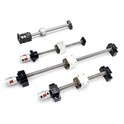

Linear shafts (also called linear rods or guide shafts) are fundamental components for providing linear guidance in mechanical systems, characterized by high straightness, wear resistance, and load-bearing capacity. Their basic structure is a cylindrical rod with a smooth surface, and some models feature keyways or threads at the ends for installation and torque transmission. The simplicity of their design makes them easy to install and cost-effective, widely used in conjunction with linear bushings or sliding blocks.
Precision grades are the core indicator of linear shafts, divided into ordinary precision (h8-h9), high precision (h6-h7), and ultra-high precision (h4-h5) according to ISO standards. Ordinary precision shafts (h8) have a straightness tolerance of 0.1-0.3mm/m and a surface roughness of Ra 0.8-1.6μm, suitable for low-precision applications such as packaging machinery and conveyor systems. High precision shafts (h6) have a straightness tolerance of 0.02-0.05mm/m and a surface roughness of Ra 0.2-0.4μm, used in CNC lathes and automated assembly lines. Ultra-high precision shafts (h4) have a straightness tolerance of ≤0.01mm/m and a surface roughness of Ra ≤0.1μm, essential for precision measuring instruments and semiconductor manufacturing equipment.
Material and surface treatment directly affect performance. The most common material is SUJ2 chrome steel, which after quenching and tempering reaches a hardness of HRC58-62, ensuring excellent wear resistance-its service life can exceed 10,000 hours in general applications. For corrosion-resistant requirements, SUS304 or SUS440C stainless steel is used; SUS304 offers good corrosion resistance but lower hardness (HRC20-25), while SUS440C combines corrosion resistance with high hardness (HRC55-58). Surface treatment methods include hard chrome plating (increasing surface hardness to HRC60-65, improving wear and corrosion resistance), black oxide coating (enhancing rust resistance and reducing light reflection), and polishing (reducing friction by improving surface finish).
Linear shafts are compatible with various matching components. When used with linear bushings (composed of a housing and rolling elements), they form a rolling guidance system with low friction (friction coefficient ≤0.005), suitable for high-speed movement. When paired with sliding bushings (made of bronze or plastic), they create a sliding guidance system with simple structure and high load capacity, ideal for heavy-duty applications. Additionally, support units (fixed side, floating side) are used to secure the linear shaft, ensuring stability during operation-fixed side support units (e.g., flange type) can withstand axial loads, while floating side units accommodate thermal expansion of the shaft.