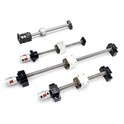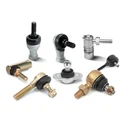

Rod end bearings, commonly known as "fish eye ball joints," are core components for converting oscillation, rotation, and linear motion in mechanical systems. They are widely used in engineering machinery, automotive steering, aerospace, and automation equipment. Their performance directly impacts the flexibility, reliability, and service life of the equipment. This article analyzes the technical points and application logic of rod end bearings from four dimensions: structural types, installation & maintenance, troubleshooting, and applicable working conditions.
Structural Types and Core Features
The design of rod end bearings focuses on "connection + rotation." The core differences lie in internal structure, sealing form, and thread adaptation, with different types suitable for different working conditions.
Internal Structure: Spherical Plain Bearing vs. Needle Roller Bearing
Spherical Plain Bearing (Radial Type):
Internally, it has a spherical sliding bearing (e.g., PTFE composite or steel-based embedded bearing), which achieves large-angle oscillation (oscillation angle up to ±30°~±60°) through "spherical contact + sliding friction."
- Advantages: Self-lubricating (maintenance-free), wear-resistant, and impact-resistant;
- Disadvantages: Lower load capacity than needle roller type, prone to overheating at high speeds;
- Applications: Light load, low speed, and frequent oscillation scenarios (e.g., automotive steering links, drone gimbals).
Needle Roller Bearing Radial Needle Roller Type
Internally, it has a needle + raceway structure, which improves load capacity and speed through "rolling friction."
- Advantages: High load capacity (radial load up to several tons) and fast speed (limit speed >5000rpm);
- Disadvantages: Requires regular lubrication, less impact-resistant than spherical plain bearings;
- Applications: Heavy load, high speed, and small oscillation angle scenarios (e.g., excavator boom, machine tool hydraulic rods).
Sealing Form: Open Type vs. Sealed Type
Open Type (No Seal):
The bearing interior is directly exposed, with a simple structure and low cost, but it is prone to dust and moisture ingress.
- Applications: Clean, dry, and less dusty indoor environments (e.g., laboratory equipment, precision instruments).
Sealed Type (Rubber/Metal Seal):
Rubber seals (e.g., Z-type/RS-type) or metal dust covers are added to the slider or threaded end to effectively block pollutants.
- Rubber seal (e.g., 2RS type): Good elasticity and strong sealing, suitable for dusty and humid environments (e.g., outdoor engineering machinery, agricultural machinery);
- Metal seal: High temperature resistance (>120°C) and oil resistance, suitable for harsh industrial environments (e.g., metallurgical equipment, chemical machinery).
Thread and Connection Method
- External Thread Type: The outer ring of the bearing has a thread (e.g., M8×1.25), which is screwed directly into the mounting hole, suitable for structures with "threaded rod ends" (e.g., hydraulic cylinder piston rods, connecting rods).
- Internal Thread Type: The inner ring of the bearing has a thread, and the rod end is screwed directly in, suitable for structures with "threaded shaft ends" (e.g., drive shafts, suspension arms).
- Flange Type: Equipped with a mounting flange (fixed with bolt holes), no thread is required. It is installed by pressing the flange surface, with strong shear resistance (e.g., heavy machinery supports).
Applicable Working Conditions: Core Basis for Selection
The service life of a bearing is strongly related to its application scenario. It is necessary to comprehensively judge based on load, temperature, environment, and motion mode.
Load Conditions
- Light Load (<100kgf): Select spherical plain bearing (self-lubricating, maintenance-free), e.g., 3D printers, small robots;
- Medium Load (100-1000kgf): Select needle roller bearing (high load capacity), e.g., forklift attachments, automation lines;
- Heavy Load (>1000kgf): Select heavy-duty needle roller + spherical plain composite bearing (e.g., TIMKEN COM series), e.g., mining machinery, wind power yaw system.
Temperature Range
- Room Temperature (-20~80°C): General-purpose type (steel-based + PTFE bearing);
- High Temperature (80~200°C): Select stainless steel + graphite bearing (e.g., SS316 + graphite embedded), e.g., metallurgical furnace doors, engine connecting rods;
- Low Temperature (-40~-80°C): Select aluminum alloy + PTFE bearing (lightweight, low-temperature resistant), e.g., polar research equipment, cold chain machinery.
Environmental Conditions
- Clean and Dry: Open-type bearing (low cost, e.g., laboratory equipment);
- Dusty and Humid: Sealed type (rubber seal, e.g., outdoor engineering machinery);
- Corrosive Media: Stainless steel bearing (e.g., chemical pipelines, marine equipment);
- Strong Impact: Spherical plain bearing (self-lubricating + cushioning, e.g., excavator breaker).
Motion Mode
- Large-Angle Oscillation (>30°): Spherical plain bearing (spherical sliding, e.g., automotive steering, drone gimbal);
- Small-Angle High-Frequency Oscillation (<10°): Needle roller bearing (rolling friction, e.g., engine valves, hydraulic valves);
- Composite Rotation + Oscillation: Select universal joint-type rod end (e.g., racing suspension, robot joints).

Conclusion
Rod end bearings are the "flexible joints" of mechanical systems. Their selection and application must focus on structural features, installation accuracy, and working condition adaptation. Only by understanding the characteristics of different types, strictly implementing the installation process, and solving problems targetedly can their value be maximized, ensuring the efficient and reliable operation of the equipment.