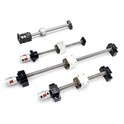

As precision transmission components, ball screws are widely used in machine tools, automated equipment, and other fields. The matching between their lead and load directly affects the operating accuracy, efficiency, and service life of the equipment. A reasonable matching scheme can maximize the performance of the transmission system; conversely, it may lead to increased positioning errors, accelerated component wear, and other issues. This article will explain the key points of matching from three aspects: core parameter analysis, matching principles, and practical techniques.
Understanding Core Parameters

Ball Screw Lead
Lead refers to the distance that the nut moves axially per full rotation of the screw, measured in millimeters (mm). A larger lead results in faster nut movement at the same rotational speed, but it also increases the required driving torque. A smaller lead, on the other hand, provides higher transmission accuracy and relatively stronger load-carrying capacity. Common lead specifications include 4mm, 5mm, and 10mm; non-standard leads can be customized for special scenarios.
Load Types and Calculation
Loads mainly include axial load, radial load, and torque load, among which axial load has the greatest impact on matching. Axial load must be calculated based on equipment working conditions, covering working load, inertial load, frictional load, etc. For example, the cutting force during machine tool cutting is the working load, and the force generated when components accelerate is the inertial load, calculated using the formula: F = ma (where m is the mass of the moving component, and a is the acceleration).

Basic Matching Principles
Balanced Relationship Between Load and Lead
Lead selection must balance load-carrying capacity and operating speed. For heavy-load scenarios (e.g., heavy-duty machine tools), priority should be given to ball screws with small leads. Their small thread lead angles provide strong axial load-carrying capacity and reduce torque loss. For high-speed, light-load scenarios (e.g., automated conveyor lines), ball screws with large leads are more suitable, as they can achieve faster feed speeds at the same motor rotational speed and improve work efficiency.
Collaborative Consideration of Precision and Load
Precision equipment (e.g., CNC machining centers) has high requirements for positioning accuracy and requires ball screws with small leads. Their small displacement per rotation enables more precise subdivision control; at the same time, the contact stress distribution of small-lead screws is more uniform, allowing high-precision operation under a certain load. If both heavy-load and high-precision requirements exist, it is necessary to use screws with high lead precision grades (e.g., Grade C1, C3) and optimize the support structure.

Practical Matching Techniques

Select Lead Based on Load Magnitude
- When the axial load F ≤ 5000N, screws with a lead of 5-10mm can be used to balance speed and accuracy.
- For loads between 5000N and 15000N, a lead of 4-6mm is recommended to enhance load-carrying capacity.
- For loads > 15000N, screws with a lead of less than 4mm must be used, combined with a double-nut structure to improve rigidity.
Adjust Lead According to Operating Speed
When the rated motor speed n is fixed, the nut speed is calculated as v = Lead P × n / 60. If the equipment requires high-speed operation, the lead can be increased, but it is necessary to verify whether the motor torque meets the load requirements. For example, the motor torque T must satisfy T = F × P / (2π × η) (where η is the transmission efficiency, usually 0.9-0.95) to avoid operation jamming due to insufficient torque.

Optimize Matching Based on Special Working Conditions
Equipment with frequent start-stop cycles requires small-lead screws to reduce the impact of inertial shock on the load. For equipment operating continuously for long periods, it is necessary to balance lead and heat dissipation to prevent excessive heat generation during high-speed operation of large-lead screws. In addition, for harsh environments (e.g., dust, corrosion), screws with good protective performance should be selected, and the lead should be appropriately reduced to improve structural stability.

Avoiding Common Misunderstandings
Some users mistakenly believe that a larger lead means stronger load-carrying capacity. In fact, the opposite is true: ball screws with large leads have large thread lead angles, resulting in reduced axial load-carrying capacity and a higher risk of deformation. Furthermore, ignoring the calculation of inertial load can lead to matching deviations; it is necessary to comprehensively consider the sum of working load, inertial load, and frictional load.
In conclusion, the matching of ball screw lead and load must be based on an understanding of core parameters, follow balanced principles, and integrate practical techniques and working condition characteristics for comprehensive decision-making. A reasonable matching scheme can give full play to the transmission advantages of ball screws and improve the overall performance and service life of the equipment.