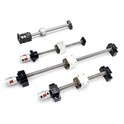

As a precision transmission component, the precision grade of a ball screw directly determines the motion accuracy and processing quality of equipment. Faced with the numerous precision standards on the market, many engineers inevitably feel confused when selecting the right grade. This article will help you quickly master the skills of choosing the precision grade of ball screws from three dimensions: precision grade classification, core factors for selection, and application in typical scenarios.

First, Master: Ball Screw Precision Grade Classification Standards
The mainstream precision grade follows the ISO 3408 standard, divided into six grades: C1, C2, C3, C5, C7, and C10, with precision decreasing in order. C1 is the highest precision grade, mainly used in ultra-precision equipment. C10 is the lowest, suitable for general transmission scenarios.
Key parameters are defined by lead error and cumulative lead error. For example, C3 grade allows a lead error of ±5μm/300mm and a cumulative lead error of no more than ±15μm/1000mm. C7 grade has a relaxed lead error limit of ±23μm/300mm and a cumulative error of no more than ±63μm/1000mm. Some manufacturers adopt the JIS standard, marked from C0 to C10, roughly corresponding to the ISO standard.
Core of Selection: Three Factors Determine Precision Grade
请替换当前内容 There are many variations of passages of available but the majority have suffered alteration in some form, by injected humou or randomised words even slightly believable. All of our products are formaldehyde free environmental protection,provide the most healthy home for you.
Equipment Precision Requirements
This is the primary basis. For equipment requiring repeat positioning accuracy within ±0.01mm (e.g., CNC machining centers, precision grinders), choose C3 or C5 grade. General automation equipment (e.g., feeding mechanisms) can use C7 grade. Heavy machinery (e.g., crane transmission systems) can adopt C10 grade.
Load and Rotational Speed
High load and speed cause thermal deformation and vibration, affecting precision. Properly upgrade the grade-for example, high-speed engraving and milling machines recommend C5 grade to offset dynamic errors.
Cost Budget
Higher precision means higher manufacturing costs, with prices differing by several times. C1 grade is 5-8 times more expensive than C7 grade. Avoid blind pursuit of high grades to prevent cost waste.

Selection Reference for Typical Scenarios
Ultra-Precision Machining Equipment
Semiconductor lithography machines, nanoscale measuring instruments-select C1-C2 grade for micrometer/nanometer-level accuracy.
High-End Machine Tools
Vertical machining centers, CNC lathes-recommend C3-C5 grade for balanced precision and stability.
Automated Production Lines
Robotic arms, conveying equipment-C5-C7 grade meets repeat positioning needs.
General Transmission Mechanisms
Lifting platforms, gate drives-C7-C10 grade offers the best cost-effectiveness.

Selection Tips
- Prioritize the equipment manufacturer's recommended precision, then adjust based on actual working conditions.
- Reserve a precision margin for complex conditions (e.g., large temperature changes, load fluctuations).
- Optimal selection matches equipment needs, not just high precision.