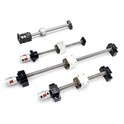

In modern industrial automation, ball screws serve as the core transmission components. The choice of material directly determines the equipment's precision, stability, and service life. To help you make the optimal decision quickly, we have summarized the key factors into the following four points:
Material Selection Based on Working Environment
- Alloy Steel (First Choice): Such as SUJ2/GCr15 high-carbon chromium bearing steel, which can reach a surface hardness of HRC 58-62 after heat treatment. It is the preferred choice for the vast majority of general automation equipment (e.g., CNC machines, injection molding machines) due to its excellent strength-to-weight ratio and wear resistance.
- Stainless Steel (Special Needs): Such as SUS440C or SUS304. When equipment operates in humid, cleanroom, or acid/base corrosive environments (e.g., food processing, medical devices, marine exploration), stainless steel must be used. This sacrifices some hardness in exchange for superior rust resistance.
Balancing Performance and Machinability
- Heat Treatment Challenges: Alloy steel becomes extremely hard after quenching, making subsequent precision grinding difficult and time-consuming. When selecting materials, confirm whether your supplier has hard-turning and precision grinding capabilities.
- Work Hardening: Stainless steel (especially austenitic stainless steel) is prone to severe work hardening, causing significant tool wear. This means the manufacturing cost of stainless steel screws is substantially higher than that of alloy steel in mass production.
Comprehensive Cost Accounting
- Material Cost: Alloy steel raw materials are inexpensive with a mature supply chain.
- Hidden Costs: Although stainless steel has a higher unit price, if your equipment is sold to coastal areas or the medical industry, the cost of returns and after-sales service due to rust is often much higher than the material price difference. Never save 5% on material costs only to incur a 50% increase in after-sales risks.
Core Conclusion
- General Scenarios: Choose Alloy Steel + Surface Rust Prevention (e.g., hard chrome plating or black oxide). This offers the best cost-performance ratio.
- Special Scenarios: You must choose Stainless Steel, and it is recommended to increase the precision grade to offset the slightly lower rigidity of the material.