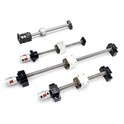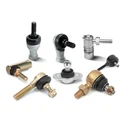

In the grand blueprint of modern industry, linear guideways function much like the bones and joints of the human body. Although they do not directly participate in production, they dictate the precision, speed, and lifespan of the entire equipment. For professionals engaged in automation equipment manufacturing and precision machining, understanding the classification and characteristics of linear guideways is not only a technical necessity but also the key to optimizing equipment performance and reducing long-term maintenance costs.
This article will walk you through the distinct types of guideways and their underlying application logic, empowering you to navigate complex industrial scenarios with ease.
Core Classification: The Ball vs. Roller Debate
The most fundamental way to classify linear guideways is by the shape of the rolling element, which directly determines the load capacity and motion characteristics.
1. Ball Type Linear Guideways
This is the most widely used type of guideway. It utilizes steel balls circulating infinitely between the slider and the rail.
- Characteristics: Due to the physics of point contact, ball guides exhibit an extremely low coefficient of friction (typically only 0.002–0.003). This makes them exceptionally adept at high-speed operation. They offer high motion sensitivity, smoothness, and relatively low noise.
- Limitations: Because the contact area is small, the pressure on each ball is immense. Therefore, when facing heavy loads or strong impacts, pitting or deformation can occur easily.
- Applications: 3C electronics manufacturing, light-duty automation lines, precision measuring instruments, and small robotic arms where speed and accuracy are prioritized.
Roller Type Linear Guideways
When equipment needs to handle heavy workpieces or perform powerful cutting, roller guides become the only choice. They replace steel balls with cylindrical rollers.
- Characteristics: The contact between the rollers and the raceway is line contact, significantly increasing the contact area. This grants the guideway astonishing rigidity and load capacity (under the same dimensions, load capacity is typically 2–3 times that of ball guides), along with superior impact resistance.
- Limitations: Due to higher friction, their maximum speed is usually lower than that of ball guides, and the cost is relatively higher.
- Applications: Large gantry milling machines, vertical machining centers, injection molding machines, punching equipment, and heavy-duty transfer robots.
Material and Environmental Adaptability
Beyond structure, material and surface treatment determine whether a guideway can "survive" in harsh environments.
1.Alloy Steel Guideways
The "universal solution" in the industry. Typically made from high-carbon chromium bearing steel (such as SUJ2/GCr15) and processed through quenching, tempering, and precision grinding.
- Advantages: Excellent comprehensive mechanical properties, hardness up to HRC 58–62, outstanding wear resistance, and high cost-effectiveness.
- Protection: Usually supplemented with hard chrome plating or black oxide coating to enhance rust prevention.
2. Stainless Steel Guideways
Born for "special environments," primarily using SUS440C or SUS304.
- Advantages: Superior corrosion resistance, capable of withstanding moisture, weak acids/bases, and salt spray. SUS304 is also non-magnetic.
- Applications: Medical devices (requiring resistance to disinfectants), food processing machinery (requiring washdown capability), marine engineering (anti-salt spray), and semiconductor cleanrooms (preventing micro-contamination).
3. Plastic/Polymer Guideways
A specialized light-load solution.
- Characteristics: Self-lubricating, quiet, extremely lightweight, and completely maintenance-free. They require no oil lubrication, eliminating the risk of oil drips.
- Applications: Food packaging lines, cleanroom transfer systems, and office automation equipment with strict noise requirements.
Accuracy Grades: From General to Nano
The accuracy of linear guideways should not be "the higher, the better," but rather "fit for purpose." Based on travel parallelism and repeat positioning accuracy, they are generally divided into three tiers:
- Normal Grade: Suitable for general automation equipment, such as transfer and sorting machinery.
- Precision Grade: Suitable for CNC engraving machines and PCB drilling machines requiring micron-level positioning.
- High Precision Grade: Reserved for semiconductor lithography machines and high-end measuring microscopes, demanding sub-micron accuracy.
Products Description
Selecting a linear guideway is essentially a balancing act between speed, load, accuracy, and cost. Ball guides excel in agility, while roller guides dominate in rigidity; alloy steel is economical and durable, while stainless steel defies corrosion.
As equipment designers or procurement decision-makers, only by deeply understanding the physical principles behind these classifications can you ensure every dollar is spent wisely, allowing your equipment to maintain its original precision and smoothness throughout its long service life.