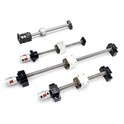

As a core component of precision transmission, the operating status of ball screws directly determines the machining accuracy and stability of equipment. During long-term use, affected by factors such as load, lubrication, and installation, faults like abnormal noise, positioning deviation, and jamming often occur. If not addressed promptly, these faults may lead to severe component damage. This article sorts out common ball screw fault types and details troubleshooting ideas and solutions to provide references for equipment maintenance.

Classification of Common Faults and Troubleshooting Logic
Most ball screw faults appear as abnormal operation, falling into four categories by symptom: abnormal noise/vibration, positioning accuracy deviation, operation jamming, and rust/wear. Troubleshooting follows the logic: "observe symptoms → analyze causes → take targeted measures". Prioritize eliminating external factors (e.g., lubrication, foreign objects) before checking internal components (e.g., balls, raceways) to avoid blind disassembly.
Specific Fault Troubleshooting and Solutions
Abnormal Noise and Vibration
Fault Symptom: Harsh noise or obvious vibration during operation, worse at high speeds.
Common Causes: Insufficient lubrication (metal dry friction); worn/damaged/missing balls; screw-nut misalignment; loose mounting bases.
Troubleshooting Steps: 1. Check lubricant amount/condition; 2. Disassemble nut to inspect balls; 3. Measure screw-nut coaxiality and bolt tightness.
Solutions: Add/replace lubricant; replace worn parts; recalibrate installation; straighten or replace bent screws.
01
Positioning Accuracy Deviation
Fault Symptom: Big gap between actual and command displacement; poor repeat positioning accuracy.
Common Causes: Accumulated screw lead error; nut wear (increased clearance); damaged support bearings; thermal deformation.
Troubleshooting Steps: 1. Test lead accuracy with a laser interferometer; 2. Measure nut backlash; 3. Check bearing flexibility and noise; 4. Monitor screw temperature.
Solutions: Replace with higher-precision screws; adjust/replace nuts; replace bearings; optimize heat dissipation or use temperature compensation.
02
Operation Jamming and Seizure
Fault Symptom: Increased operation resistance, intermittent jamming, or inability to rotate.
Common Causes: Foreign objects jamming balls; improper/caked lubricant; rusted screws (tight fit); excessive nut preload.
Troubleshooting Steps: 1. Disassemble nut to clean foreign objects; 2. Check for lubricant caking; 3. Inspect screw for rust/scratches; 4. Test nut preload.
Solutions: Clean and reload with suitable lubricant; derust or replace screws; adjust preload to a reasonable range.
03
Rust and Wear
Fault Symptom: Rust/scratches on screws; severe wear on nut inner walls.
Common Causes: Inadequate lubrication/protection (moisture intrusion); dusty/corrosive environment; long-term overloading (fatigue wear).
Troubleshooting Steps: 1. Check seal integrity; 2. Observe environment (dust, humidity); 3. Evaluate if load exceeds rated capacity.
Solutions: Strengthen sealing and add anti-rust lubricant; install dust-proof/anti-corrosion devices; control load; polish light rust or replace severe cases.
04
Preventive Maintenance Recommendations
Set regular lubrication with suitable lubricant to avoid dry friction
Clean screw impurities and check seals regularly

Test accuracy/operation periodically and fix abnormalities promptly
Control environment temperature/humidity to avoid extreme-condition operation.