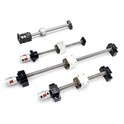

We are the largest Business expert
While retaining the core principle of rolling friction, it utilizes micro-processing techniques to achieve ultra-fine feed capability and fit into tight installation spaces.
Compared to standard ball screws, miniature variants emphasize fine positioning accuracy under minimal lead conditions. They often employ internal ball return systems to minimize nut size and are frequently available in stainless steel (SUS440C/SUS304) to meet the stringent requirements of medical and cleanroom environments.
Differences from Trapezoidal (Lead) Screws
| Comparison Dimension | Miniature Ball Screw | Trapezoidal (Lead) Screw |
| Friction Principle | Rolling friction (μ≈0.003–0.01) | Sliding friction (μ≈0.1–0.2) |
| Transmission Efficiency | 90% – 95% | 25% – 50% |
| Positioning Accuracy | C3–C7 grades, μm-level repeatability | Limited accuracy, degrades with wear |
| Self-locking | No backdriving; brakes needed for vertical use | Self-locking possible with small leads |
| Micro-feeding | No stick-slip; μm-level precision | Prone to stiction/crawling at low speeds |
| Cost | Higher; requires lubrication/dust protection | Low; robust against contamination |
Summary: Trapezoidal screws are suitable for low-speed, self-locking, cost-sensitive applications (e.g., manual lift tables). Miniature ball screws excel in applications requiring high-precision micro-positioning and frequent start-stop cycles in automated equipment.
Differences from Standard Ball Screws
Standard ball screws start at diameters of 20mm and handle loads of several tons. Miniature screws (≤16mm) have dynamic load ratings typically in the hundreds to low thousands of Newtons, designed specifically for light-load precision positioning.
Miniature screws offer extremely fine leads (0.5/1/2mm). Standard screws usually feature leads ≥5mm, prioritizing high speed and thrust.
Miniature screws predominantly use internal deflectors (compact, smooth running). Standard screws often use external tube returns (better for large leads and high DN values).
Due to ball size limitations, miniature screws typically feature light preload (1%–2% of Cda). Standard screws can achieve medium/heavy preload via double nuts or oversized balls.
Stainless steel versions are common in the miniature series (for corrosion resistance and cleanrooms), whereas standard series primarily use SUJ2/GCr15 alloy steel.
Respective Advantages & Typical Applications
Advantages of Miniature Ball Screws: Compact size, high efficiency, zero stick-slip micro-feeding, availability of C3/C5 accuracy grades, and stainless steel options for corrosion resistance.
Applications: Semiconductor wafer positioning stages, optical focusing mechanisms, medical micro-injection pumps, surgical robot joints, 3C SMT pick-and-place Z-axes, and humanoid robot finger joints-anywhere space is limited but μm-level precision is mandatory.
Advantages of Standard Ball Screws: High load capacity, high rigidity, multiple preload grades, and suitability for long-stroke, high-speed operation.
Applications: CNC machine tool tables, heavy-duty automation lines, injection molding machine injection units, and large-scale inspection equipment.
Advantages of Trapezoidal Screws: Self-locking capability, usable without lubrication, resistant to dust, and extremely low cost.
Applications: Manual adjustment mechanisms, low-speed clamping devices, valve actuators, and simple lift tables.
Selection Guidelines
Vertical Axis Safety: Always equip vertical applications with a power-off brake to prevent backdriving and falling.
Critical Speed & DN Value: Pay close attention to critical speed limits and DN values, especially with very fine leads.
Environment: Opt for stainless steel construction with integral seals in wet, corrosive, or cleanroom environments.
Preload: Light preload is sufficient for most micro-positioning tasks; avoid excessive preload which increases starting torque and heat generation.
With the growing demand for miniaturization in advanced manufacturing, miniature ball screws are progressively replacing trapezoidal screws and pneumatic cylinders, establishing themselves as the core component for micro-transmission in high-end equipment.