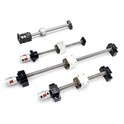

As a core guiding component in mechanical transmission systems, the material selection of linear shafts directly determines the operational stability, service life, and application range of equipment. Traditional linear shafts mostly use carbon steel materials, which can meet basic transmission needs but have obvious performance shortcomings under complex working conditions. With the widespread application of stainless steel in linear shaft manufacturing, its all-round performance improvement provides strong support for the upgrading of mechanical equipment. This article will deeply analyze the key performance changes and application value brought by the material upgrade of linear shafts from carbon steel to stainless steel.

Comparison of Basic Properties Between Carbon Steel and Stainless Steel Linear Shafts
Traditional carbon steel linear shafts are mainly represented by Grade 45 steel and 40Cr steel. Through quenching and tempering, surface quenching, and other processes, they can achieve a certain level of hardness and wear resistance, but they inherently have material shortcomings: high carbon content leads to poor corrosion resistance, making them prone to rust when exposed to moisture and dust; their toughness and impact resistance are limited, and fatigue cracks are likely to occur under long-term heavy loads or frequent start-stops.
Stainless steel linear shafts mainly use austenitic stainless steels such as SUS304 and SUS316. With a chromium content of ≥18% and a nickel content of ≥8%, they undergo solution treatment and precision grinding. Not only do they retain the high strength of metals, but they also have the unique property of a passive film, which can effectively resist the erosion of corrosive media. Meanwhile, they perform better in terms of toughness and low-temperature resistance.
Core Performance Improvements Brought by Material Upgrade
Qualitative Leap in Corrosion Resistance
Qualitative Leap in Corrosion Resistance
Carbon steel rusts in humidity, accelerating wear and reducing accuracy. Stainless steel's passive film isolates air/moisture, maintaining smooth surfaces in outdoor/humid environments. SUS316 (with molybdenum) excels in acid/alkali/salt spray, fitting chemical/marine scenarios.
01
Significant Extension of Service Life
Carbon steel shafts last only thousands of hours (due to rust/friction) and need frequent replacement. Stainless steel shafts, with better wear/corrosion resistance, have a 3-5x longer service life. Their smoother surface reduces friction with bearings, cutting maintenance costs.
02
Greatly Expanded Application Range
Carbon steel works only in dry, clean indoor areas. Stainless steel handles humidity/dust and operates stably at -270°C to 400°C: oxidation resistance prevents high-temperature degradation, and good toughness avoids low-temperature brittleness, suiting test equipment/outdoor machinery.
03
Effective Reduction of Maintenance Costs
Carbon steel requires regular rust removal/oiling to avoid failures. Stainless steel shafts need only occasional surface cleaning (no frequent lubrication/rust prevention), reducing workload and downtime losses.
04

Application Scenarios and Precautions
Stainless steel shafts are widely used in precision machinery, automation, medical devices, and food processing-e.g., meeting hygiene standards in food machinery (no rust contamination) and ensuring accuracy in precision instruments.
Notes: Stainless steel shafts are slightly less hard than quenched carbon steel. For heavy loads/high-speed impacts, use surface hardening (nitriding, chrome plating). Also, stainless steel costs more, so balance needs and budget during selection.
Conclusion
The shift from carbon steel to stainless steel for linear shafts is inevitable for high-performance, reliable machinery. Stainless steel's improvements in corrosion resistance, service life, and adaptability solve carbon steel's flaws and drive equipment toward harsher, more precise applications. With advancing material tech, stainless steel shafts will be further optimized, supporting industrial automation upgrades.