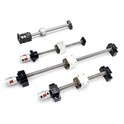

In scenarios such as metallurgical forging, glass processing, aero-engine testing, and high-temperature drying equipment, sustained high temperatures (often ranging from 200℃ to 500℃) can cause problems like material softening, lubrication failure, and precision drift in traditional linear guides. These issues severely affect the operational stability and service life of equipment. High-temperature-resistant linear guides, through material innovation, structural optimization, and lubrication technology upgrades, establish a comprehensive high-temperature protection system. They serve as the core guarantee for the stable operation of precision equipment in harsh high-temperature environments, solving the problem of high-temperature adaptation while maintaining high-precision guiding performance.

Core Technical Support for High-Temperature-Resistant Linear Guides
The durability of high-temperature-resistant linear guides stems from multi-dimensional technological breakthroughs. In terms of material selection, high-temperature alloys (such as Inconel alloy and Hastelloy) or high-temperature-resistant stainless steel (such as SUS310S) are preferred. These materials can maintain high strength and rigidity in high-temperature environments, preventing deformation caused by temperature rise. For some heavy-load scenarios, ceramic matrix composites are used, which combine high-temperature resistance and wear resistance, and can withstand extreme high temperatures above 500℃.
In structural design, high-temperature-resistant guides abandon traditional plastic components. Key parts such as sliders and cages are integrally formed using metal materials to prevent plastic melting or aging under high temperatures. At the same time, the heat dissipation structure is optimized: hollow designs or thermal conductive coatings are used to accelerate heat transfer and reduce local temperature accumulation. The lubrication system is crucial for high-temperature adaptation. Solid lubricants (such as molybdenum disulfide coatings and graphite) or high-temperature-specific greases (with heat resistance up to 300℃ or higher) are adopted to avoid the failure and loss of traditional greases at high temperatures, ensuring smooth operation of moving parts.
Key Selection Points for High-Temperature Environments
Match Materials to Temperature Ranges
For medium-temperature environments (200℃-300℃), high-temperature-resistant stainless steel guides can be used, balancing cost and performance. For high-temperature environments (300℃-500℃), products made of high-temperature alloy materials are required. For extreme high-temperature environments (above 500℃), priority should be given to linear guides made of ceramic matrix composites to ensure that the maximum high-temperature resistance of the material covers the actual operating temperature.
01
Balance High-Temperature Resistance and Mechanical Performance
High-temperature adaptation should not compromise the core performance of the guide. When selecting, attention should be paid to rated load, rigidity, and precision indicators: for heavy-load high-temperature scenarios, roller-type high-temperature-resistant guides can be used, as their load-bearing capacity is higher than that of ball-type guides; for precision high-temperature equipment (such as aero-parts testing equipment), the positioning accuracy of the guide must be ≤±0.01mm to avoid guiding precision deviations caused by high-temperature deformation.
02
Emphasize Lubrication and Sealing Systems
Lubrication failure at high temperatures is the main cause of guide damage. It is necessary to select a lubrication solution suitable for high-temperature working conditions: solid lubricants are suitable for oil-free environments or extreme high-temperature scenarios, while high-temperature greases need to be replenished regularly. At the same time, metal sealing structures should be used to block high-temperature dust and debris from entering the interior of the guide, avoiding increased wear.
03
Consider Installation and Maintenance Convenience
High-temperature-resistant guides with modular designs are preferred for easy installation and debugging in high-temperature environments. Some products are equipped with temperature monitoring interfaces, which can real-time monitor the operating temperature of the guide and issue timely warnings for abnormalities. During maintenance, high-temperature-specific tools must be used to avoid operational safety risks caused by insufficient heat resistance of tools.
04

Core Application Advantages and Scenario Value
The core advantage of high-temperature-resistant linear guides lies in the dual guarantee of "high-temperature tolerance + high stability". In terms of durability, their service life is more than 40% longer than that of traditional guides. They can effectively resist material aging and lubrication failure caused by high temperatures, reducing equipment downtime for maintenance. In terms of precision retention, high-temperature materials and structural designs prevent precision drift of the guide due to thermal expansion and contraction, ensuring stable precision during long-term operation.
Their application scenarios have covered various high-temperature fields: in metallurgical forging equipment, high-temperature-resistant guides carry the transportation of high-temperature workpieces, ensuring continuous operation of the production line; in glass processing machinery, they withstand temperatures above 300℃ around the furnace body, ensuring glass forming precision; on aero-engine testing platforms, they achieve precise positioning of parts in a 400℃ high-temperature environment, providing reliable support for performance testing.
As industrial production extends to high-temperature and high-precision fields, requirements for high-temperature resistance of equipment components are becoming increasingly strict. High-temperature-resistant linear guides are not only "durable solutions" to solve high-temperature adaptation problems but also "optimized choices" that balance precision, efficiency, and operation and maintenance costs. They provide reliable support for precision manufacturing in harsh high-temperature environments and drive related industries toward more extreme and efficient development.