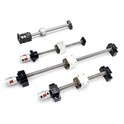

Ball Screw Selection Guide: Scientific Decision from Parameters to Scenarios
As a core component of precision transmission, ball screws are widely used in CNC machine tools, automated machinery, robots and other equipment. Their selection directly determines the precision, efficiency and service life of the equipment. Wrong selection may lead to transmission jamming, precision attenuation or even component damage, so mastering scientific selection methods is crucial.
1. Core Parameters: The Basic Scale for Selection
1. Load Capacity: This is the primary indicator for ball screw selection, which needs to distinguish between dynamic load and static load. The dynamic load rating (C) refers to the maximum load that the screw can still work stably under 1 million cycles, which is suitable for high-frequency motion scenarios; the static load rating (C0) corresponds to the load-bearing limit of static or low-speed working conditions, such as clamping mechanisms. For example, ball screws used in stamping automation need to focus on dynamic load to cope with continuous reciprocating motion.
2. Precision Grade: Ball screw precision is usually divided into multiple grades from C0 to C10, and the smaller the grade number, the higher the precision. Grades C3-C5 are suitable for high-precision equipment such as CNC machining centers, and the positioning error can be controlled within 0.01mm; grades C7-C10 meet the needs of ordinary transmission, such as the drive mechanism of the conveyor line, with higher cost performance. When selecting, it is necessary to combine the positioning accuracy requirements of the equipment to avoid cost waste caused by "excessive precision".
3. Lead: Lead refers to the distance that the nut moves when the ball screw rotates one week, which directly affects the transmission speed and thrust. Large lead (such as more than 10mm) is suitable for high-speed and low-thrust scenarios, such as fast feeding of packaging machinery; small lead (such as 2-5mm) is used for low-speed and high-thrust working conditions, such as the clamping mechanism of injection molding machines. It should be noted that under the same speed, the lead is proportional to the moving speed and inversely proportional to the output thrust.
2. Scenario Adaptation: The Key Basis for Selection
In harsh environments, the protection design of ball screws is crucial. For woodworking machinery with more dust, ball screws with dust covers should be selected to prevent wood chips from entering the ball track; in humid or corrosive environments (such as chemical equipment), ball screws made of stainless steel or with chrome-plated surfaces should be preferred to improve corrosion resistance.
In addition, the installation space will also limit the selection. For compact spaces such as small robot arms, miniature ball screws can be used; while large gantry machine tools need to be matched with large-diameter ball screws to ensure rigidity.
3. Selection Misunderstandings: Avoid These "Pits"
Many users only take "diameter" as the selection standard, ignoring the matching of lead and precision. For example, ball screws of the same diameter have large thrust with small lead, but insufficient speed, which cannot meet the needs of high-speed equipment. The correct way is to first clarify the three core requirements of the equipment: load, speed and precision, then screen the parameters combined with the installation environment, and consult the manufacturer for simulation calculations if necessary.