

Engineered from high-strength aluminum alloy (Grade 6061-T6 with enhanced mechanical properties), these precision-machined aluminum coupling are developed for industrial applications demanding lightweight construction and long-term durability. Featuring innovative structural optimization, the series achieves millimeter-level transmission accuracy while minimizing energy loss during operation. With specialized anti-oxidation surface treatment resistant to humid, salt-spray environments, they demonstrate proven performance across automated production lines, precision medical equipment, and new energy vehicle power systems - maintaining flawless operation through 10,000-hour endurance validations.
Core Advantages
.
Technology First
We offer a variety of transmission components
Lightweight & High-efficiency Design
Made of aluminum alloy, whose density is only 1/3 that of steel, significantly reducing the weight of the transmission system, lowering motor energy consumption, and improving equipment response speed. It is an ideal choice for precision machinery.
Excellent Corrosion Resistance
The surface can be treated by anodizing or electrophoretic coating to form a dense oxide film, effectively resisting corrosion from moisture, acid and alkali solutions, and extending the service life of the equipment.
High-precision & Low-noise Transmission
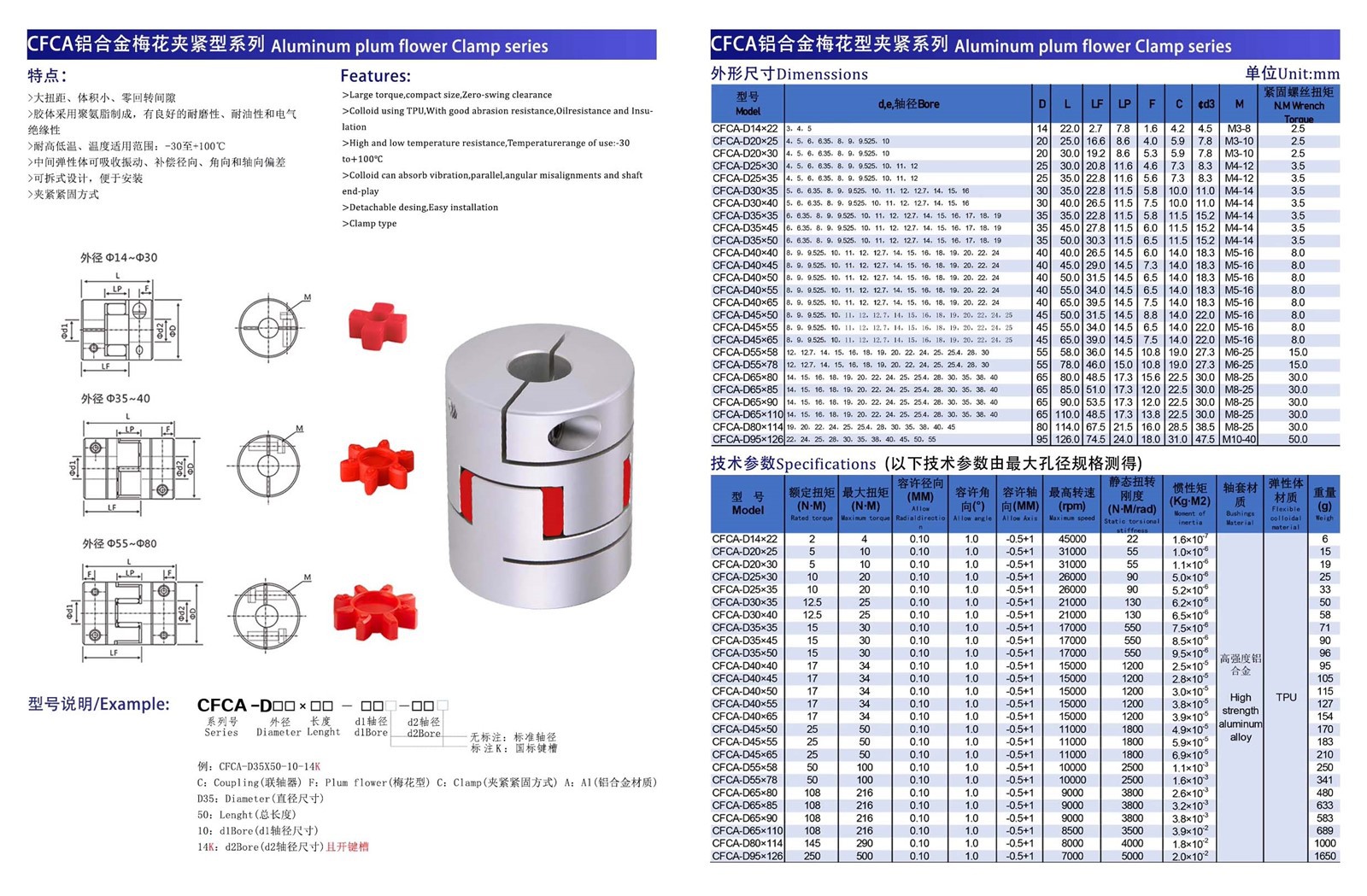
Precisely machined connecting components can effectively compensate for shaft deviations (radial deviation ≤ 0.1mm, angular deviation ≤ 1°), reducing transmission errors and enabling stable operation with low vibration and low noise.
High Adaptability & Cost-effectiveness
Multiple specifications are available (shaft diameter Φ5-Φ50mm, torque 5-200N·m). Flange types support customization such as single flange, double flange, clamping type, and diaphragm type, adapting to different working environments.
Technical Specifications

Application Scenarios


Usage Instructions
- Ensure coaxiality of the two shafts before installation to avoid abnormal wear caused by excessive misalignment;
- Fix the flange with matching bolts and tighten them to the specified torque (refer to technical parameters);
- Regularly check for loose connections and keep the surface clean and debris-free;
- Add a protective cover in harsh environments to extend service life.
FAQ
Q1: What are the advantages of aluminum couplings compared to steel couplings?
A1: Key advantages include:
• Engineered Advantages:
• 1. Lightweight Design: Weighing merely one-third of traditional steel counterparts, this configuration substantially lowers motor strain, enhances operational agility, and delivers energy efficiency benefits;
• 2. Superior Corrosion Protection: Anodized/electrophoretic surface treatments enable exceptional resistance to moisture, acidic, and alkaline exposure, maintaining performance in demanding environments;
• 3. Economic Efficiency: Offers competitive pricing for equivalent specifications, while its maintenance-free engineering minimizes lifecycle expenses;
• 4. Precision Engineering: CNC-machined components guarantee smooth, low-vibration operation with enhanced shaft misalignment accommodation, outperforming conventional steel alternatives in transmission accuracy.
Q2: What is the maximum torque your aluminum coupling can withstand? Does it support high-torque applications?
A2: The standard torque range is 5-200N·m. For higher torque requirements (e.g., over 200N·m), customized solutions are available through thickened flanges and optimized structural design. Please contact our engineers to discuss your specific working conditions.
Hot Tags: aluminum coupling, China aluminum coupling manufacturers, factory, coupling, Membrane Aluminum Coupling, Ball Screw Coupling, Plum Blossom Coupling, Aluminum Coupling